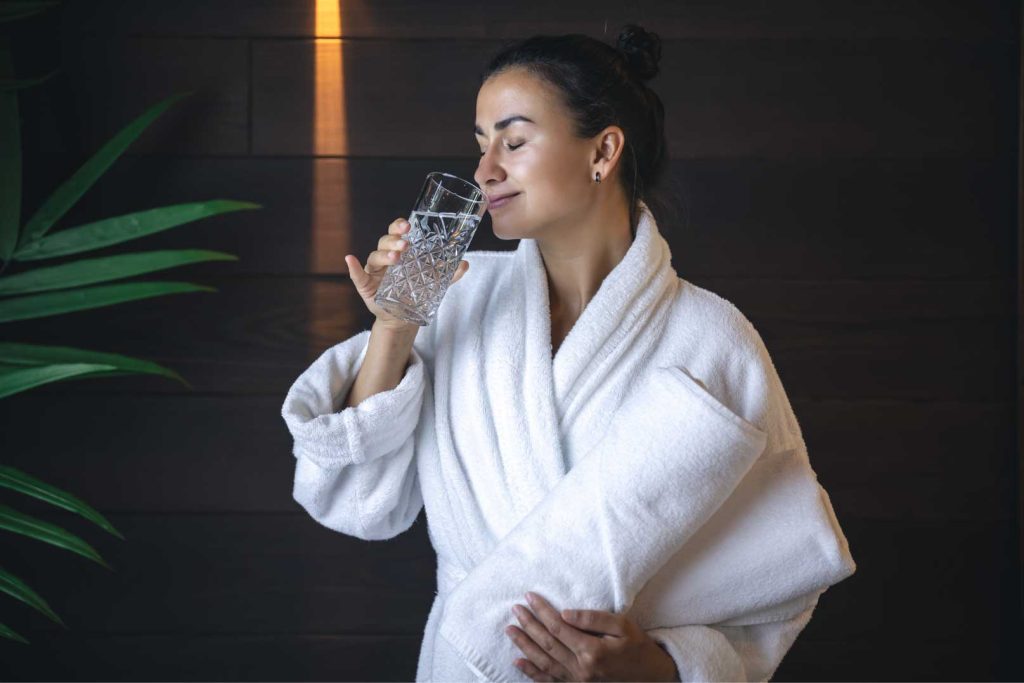
If you’ve ever gone for a treatment with a Registered Massage Therapist (RMT), there’s a good chance you’ve been told to “drink lots of water” afterward. I used to tell my clients this too, because that’s what I was taught. It turns out, however, that this is just one of the myths passed down from therapist to therapist with zero scientific backing.
I’d like to go through the most common reasons I’ve heard for this advice.
Reason #1: It Will Help to Flush Out “toxins”
Ugh, why does it seem that so much health misinformation these days involves “toxins”? What toxins? I assume most people are referring to lactic acid when they say this.
Lactic acid is not a toxin. When your muscles burn energy, they produce a byproduct called lactic acid, which the body then reuses for more fuel. Lactic acid is produced when muscles work really hard and run out of oxygen (anaerobic metabolism). This process happens during intense workouts—not during a massage. Even during an intense workout, the body clears the lactic acid within 30 to 60 minutes.
Drinking extra water does not speed up this process, and there is zero scientific evidence that receiving a massage produces lactic acid in the first place. Also, please stop picking on lactic acid.
Reason #2: It Will Help Reduce Delayed Onset Muscle Soreness (DOMS)
The exact cause of DOMS is not known. Most research indicates it is caused by a cascade of events rather than a single factor, starting with “micro-tears” that trigger an inflammatory response. There is even a new theory suggesting that the pain stems from the fascia rather than the muscle itself. (And FYI: it’s not caused by lactic acid!)
Whatever the causes of DOMS may be, drinking water is not going to help. You can’t “flush” the pain out. Time, active recovery, sleep, and even a lighter massage treatment (vs. a massage with firm pressure that may cause and/or contribute to DOMS) are what actually help reduce DOMS.
Reason #3: Massage Therapy Dehydrates You
Unlike exercise, massage therapy doesn’t cause dehydration because you aren’t sweating. Some people may feel the need to use the washroom after a treatment due to “fluid shifting.” The pressure of a massage can move interstitial fluid (the fluid between your cells) into other systems of your body, which can trigger your kidneys to filter this additional fluid. This is simply a shift in fluid distribution, not a net water loss that would lead to dehydration.
When Drinking Water is Actually Helpful
Even slight dehydration can reduce muscle performance; muscles may feel tighter and stiffer, and you may experience DOMS more intensely, as it can alter your pain perception. So, while drinking more water once you already have DOMS won’t help, staying hydrated beforehand can keep the muscles more pliable. More pliable muscles will also help with your massage therapy treatment.
The Bottom Line
We need to drink water to stay healthy and keep our bodies functioning correctly. The exact amount of water an individual needs is beyond the scope of this article and beyond my scope of practice as an RMT. Telling everyone to drink “eight glasses a day” is too simple an answer. Everyone’s needs are different, and I encourage you to speak with your primary care physician if you have concerns regarding your water intake.
As for drinking water after a massage: if you are thirsty, drink up! Otherwise, there is no need to worry.
Kim McLellan, RMT